PR Code Reviews: how CodeCrab unblocks your team in the AI era
AI writes more code than ever, so review queues are the new bottleneck. Here is how CodeCrab reviews Pull Requests locally, with repo-specific skills and full engineer control.
Reviewing Pull Requests used to be the quiet part of shipping software. It is now the loudest bottleneck on most teams. AI assistants generate code faster than any human can read it, so the queue of open Pull Requests keeps growing while the team waits. CodeCrab attacks that queue from the reviewer's side: a native desktop app that reviews diffs in seconds, entirely on your own machine.
The problem: more generated code, same review capacity
Three things happen at once on a modern team. AI produces large volumes of code, so Pull Requests get bigger and land more often. Reviewers stay human, so throughput does not change. And AI still gets things wrong — subtle logic mistakes, missing edge cases, unsafe assumptions, patterns that do not match how this specific repository works.
The result is the worst of both worlds: a backlog that blocks your teammates, and a growing temptation to rubber-stamp diffs nobody truly read. Review is exactly the step you cannot skip in an AI-heavy workflow, because it is the only place where those mistakes are caught before production.
Why a generic reviewer is not enough
Most automated reviewers apply the same rules to every repository. That catches the obvious things and misses the ones that actually break your product. Real defects tend to be contextual: the wrong service boundary, a query that ignores a tenant filter, a migration that does not match your deployment order, a convention your team agreed on two quarters ago.
That is why CodeCrab builds an adaptive profile per repository and works with custom skills. You encode what matters in this codebase — its architecture, its rules, its traps — and the review is tuned to it. You can also plug in the skills you already maintain for Claude Code or Cursor instead of rewriting them.
Business context, not just code context
Good review also needs the why. Context from Jira — the ticket, the acceptance criteria, the linked incident — turns "this code is odd" into "this code does not do what the ticket asked for". Deeper business context is where CodeCrab is heading next: connecting sources such as Google Drive and Glean so the reviewer understands the product decision behind the diff, not only the syntax of it.
The list GitHub never gave you
Part of the bottleneck is not review speed, it is visibility. GitHub has no single place that shows you every Pull Request you should look at, so PRs go quiet for days and authors ping people in chat to get unstuck.
- All open PRs in one list, every morning, without hunting through notifications.
- PRs assigned to you, so nothing you own sits in limbo.
- PRs that belong to your team even when you were not requested — the ones you can pick up to unblock a teammate today.
With the full picture in front of you, reviewing becomes a short, deliberate routine instead of a reactive scramble.
How a review actually runs
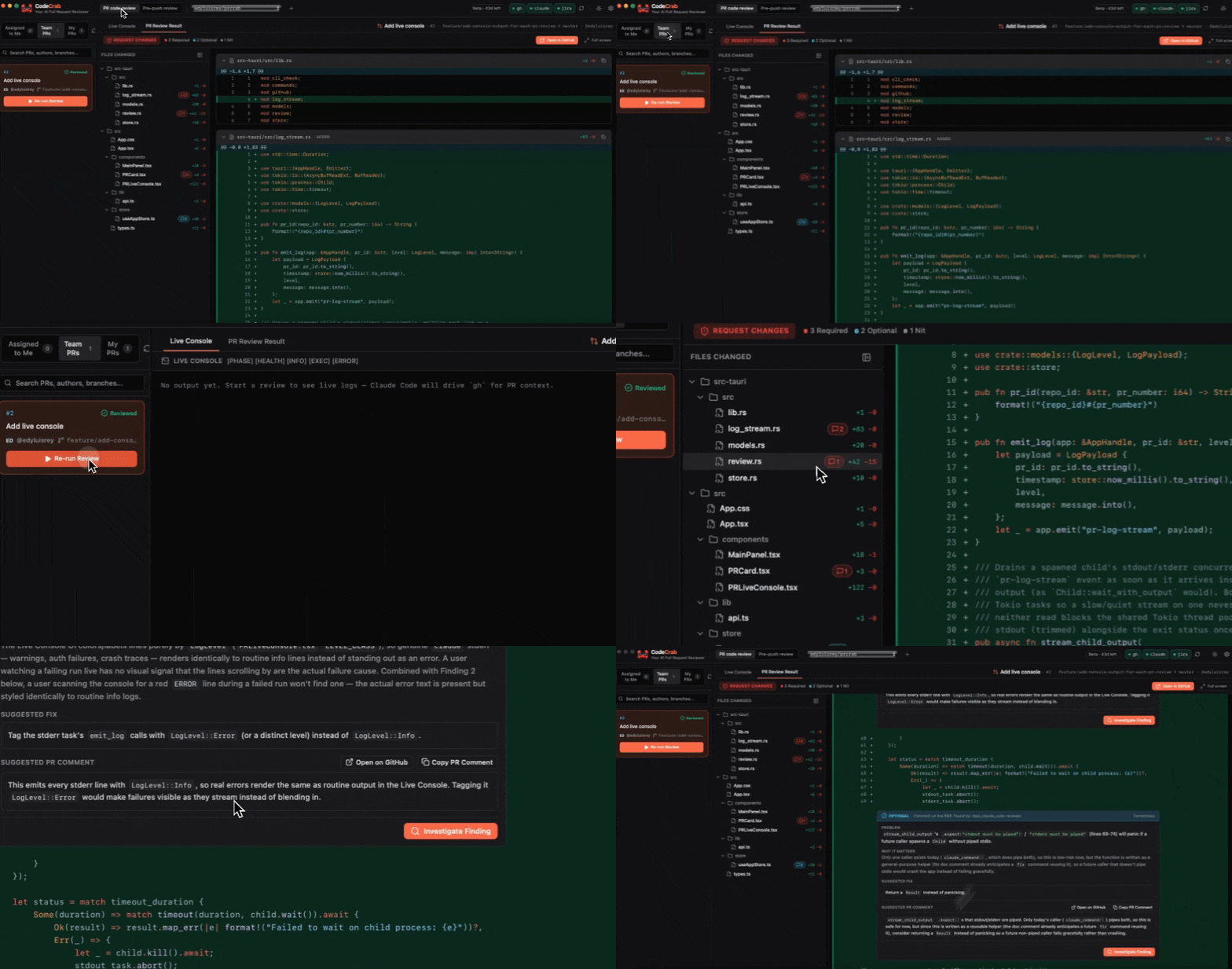
- Open a Pull Request from the list. CodeCrab loads the diff locally — file tree, changed lines, multi-file navigation.
- It orchestrates the CLIs and subscriptions you already pay for (Claude Code, Cursor) against your local checkout, using your repository profile and skills.
- Observations land inline on the diff, next to the code they refer to, with a live execution console so you can see exactly what ran.
- When something is unclear, you investigate further and ask follow-ups until the issue is actually understood — not just flagged.
A side effect worth naming: you learn faster
Investigating findings you would not have spotted alone is one of the fastest ways to grow as an engineer. Every follow-up teaches you something about the codebase, the failure mode, or the domain. The tool does not replace your judgement; it feeds it.
Read-only by default, and you stay in control
CodeCrab is read-only today. It never commits, never pushes, and never posts a public GitHub comment on its own. When the reviewer finds an issue, you decide whether it becomes a comment on the PR, a bug to file, or a note you keep to yourself because context says otherwise.
Publishing findings automatically is on the roadmap as an opt-in write mode — because the moment a bot can comment on its own, PRs fill with noise. The default will always be your call.
The short version
- AI writes more code, so review — not authoring — is the new bottleneck.
- AI also still makes mistakes, so review matters more, not less.
- Repo-specific skills and profiles catch what a generic reviewer cannot.
- Ticket and business context turn findings into decisions.
- One complete PR list stops work from stalling in silence.
- Read-only by default: your experience and criteria decide what ships.
Try it on your next Pull Request
Free Public Beta — runs 100% on your machine. No code leaving your laptop.
Download CodeCrabKEEP READING
My PRs — Feedback: turn vague review comments into a clear fix
Generic or unclear feedback on your Pull Request stalls you for days. CodeCrab investigates every comment with full local code context and hands you a ready-to-run fix prompt.
Pre-Push Code Review: catch bugs before the Pull Request even exists
The cheapest bug is the one that never reaches a PR. CodeCrab reviews your local changes with your repo's own profile and skills, so you push higher-quality code the first time.