Pre-Push Code Review: catch bugs before the Pull Request even exists
The cheapest bug is the one that never reaches a PR. CodeCrab reviews your local changes with your repo's own profile and skills, so you push higher-quality code the first time.
You finish your work locally, everything looks ready, so you push and open the Pull Request. And then the loop starts: a few comments trickle in — some about real bugs, many about small things that could have been caught before you pushed. Each round means fixing locally, committing again, pushing again, re-requesting review, and often pinging a reviewer internally just so they notice the update.
Every one of those round trips is slow, and worse, it blocks the whole team: your PR sits in review, your reviewer's attention is split, and work that could have been merged today ships tomorrow. A lot of that friction is avoidable — and that is exactly what the Pre-Push Code Review in CodeCrab is for.
The problem: bugs are cheapest before they reach a PR
Once a bug is in a Pull Request, the cost multiplies. The reviewer has to find it, describe it, and you have to reproduce it, fix it, and publish again. Every cycle of comment → fix → push → re-review adds hours, sometimes days. The fastest review is the one that never needs to happen: catch the issue while the code is still local, before anyone else sees the diff.
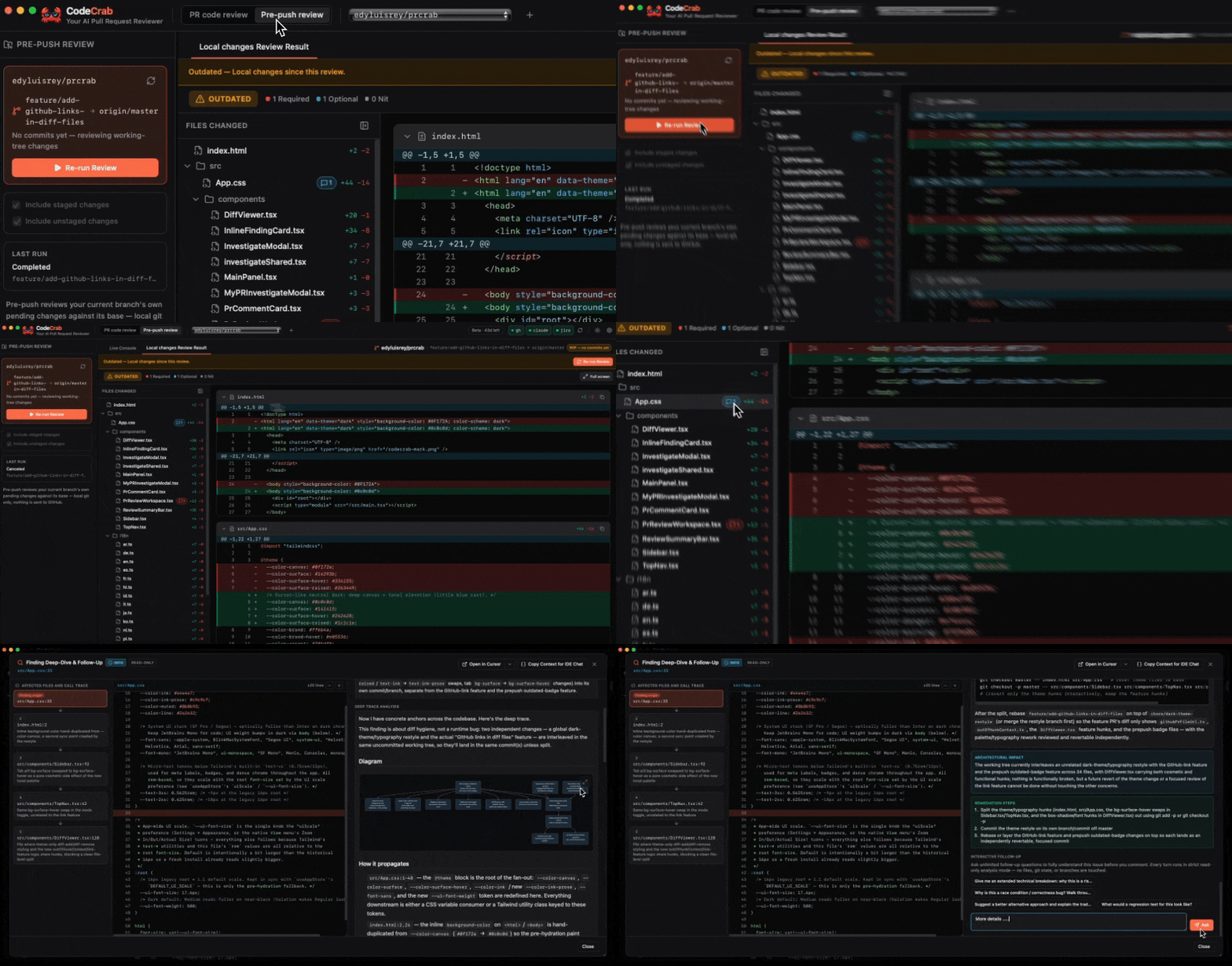
That is what pre-push review does: CodeCrab performs a read-only review of your local changes — before the commit, or right after it — and surfaces problems while the context is still fresh in your head.
What it catches, tuned to your repository
The review is not a generic linter. Because CodeCrab learned your repository's rules and patterns upfront, it reviews along the axes that matter for your project:
- Correctness — logic flaws, broken edge cases, regressions in behavior.
- Security — injection risks, unsafe data handling, exposed secrets, auth gaps.
- Readability & Simplicity — code your teammates will struggle to understand or maintain.
- Architecture — changes that break layering, leak responsibilities or fight the codebase's structure.
- Performance — accidental complexity, N+1 patterns, unnecessary work in hot paths.
- Anything else that is important for your repository — the review profile is yours to define.
Your local skills, combined with CodeCrab
The review runs with the skills you already have — Claude Code, Cursor, and your own custom skills — working together with CodeCrab's review engine. The adaptive profile learned from your repo, your skills, and your criteria all feed the same review. Nothing replaces your workflow: it amplifies it, and the more you customize, the more productive the review becomes. And because everything runs on your machine, your source code never leaves your laptop.
Investigate any finding, deeply
When the review finds a bug or a risky pattern, you don't have to take it at face value. Open the finding and investigate it as deeply as you need — with the stack trace, the code change graph, and diagrams that make the problem visible instead of hypothetical. You understand the issue fast, and along the way you learn things about your codebase you would not have spotted on your own.
From understanding to a ready-to-run fix
Once the problem is clear, CodeCrab gives you a fix prompt ready to hand to Claude Code or Cursor — pre-filled with the relevant files, the intent of the finding and your repository's constraints. It is fully editable: if you disagree with the framing, rewrite it. Your criteria stay in the loop, always.
Read-only today, one-click fix next
Today the pre-push review is read-only: nothing is committed, pushed or published without your explicit approval. The next step is a one-click fix — you approve, and in the background your local model applies the change and runs your full test suite on your machine.
That last part matters more than it sounds. One of the best ways to keep AI-generated code from breaking production is a robust test setup — unit, functional and integration tests. You already have that environment configured locally, because you run it manually every day. Cloud review bots can't touch it; CodeCrab can. Your local Claude Code or Cursor setup can run those tests against every change, so you can iterate on fixes without limits, verify each one, and only push when the code is genuinely ready.
Where this is going
The pre-push review is the foundation for a faster local workflow. On the roadmap: multi-branch and parallel branch support, so you can work on several changes at once, and controlling commit and push directly from the app, fully automated once you approve. The direction is always the same: more speed, more quality, and every decision stays yours.
Try it on your next Pull Request
Free Public Beta — runs 100% on your machine. No code leaving your laptop.
Download CodeCrabKEEP READING
GitHub Copilot Code Review: How It Works, Custom Instructions and Local Reviews
How GitHub Copilot code review works on Pull Requests, how to customize it with copilot-instructions.md, and how to review your branch locally with Copilot CLI before pushing.
GitLab AI Code Review: How to Review Merge Requests Locally with AI
Review GitLab merge requests with AI on your own machine: glab mr checkout, view and diff, a copy-ready review prompt for Claude Code, Cursor, Codex or Copilot CLI.
How to Use Cursor for Code Review: Review Rules, Diff Checks and PR Workflows
Use Cursor for code review: review your branch before pushing, review PRs with the GitHub CLI, use Bugbot, and add a copy-ready .cursor/rules code review rule.
Can Claude Code Review PRs? How to Review a Pull Request with Claude Code (Step by Step)
Yes, Claude Code can review Pull Requests. Learn three ways to review a PR with Claude Code: pre-push branch reviews, GitHub CLI PR reviews and repeatable claude -p reviews, with copy-ready prompts.
The AI-Era Code Review Checklist: How to Review AI-Generated Code (and Vibe-Coded PRs)
A practical code review checklist for AI-generated code: verify authorization, API contracts, data integrity and tests, with copy-ready review templates and a repository-aware prompt.
Cursor Bugbot vs Codex vs Claude Code: Which AI Reviews Pull Requests Best?
Compare Cursor Bugbot, OpenAI Codex and Claude Code for PR and pre-push reviews: triggers, repository rules, permissions, privacy, practical prompts and a fair evaluation method.
Claude Code Subagents for Code Review: Security, Performance and Architecture Reviewers
Build three specialized Claude Code review subagents with copy-ready definitions: a security reviewer, a performance reviewer and an architecture reviewer, each with isolated context and read-only tools.
Best AI Code Review Tools in 2026: CodeRabbit vs Greptile vs Qodo vs Cursor Bugbot vs CodeCrab
A no-pricing comparison of the leading AI code review tools: where your code goes, what permissions you grant, how much context the reviewer sees, and when the review happens.
Claude Code Skills for Code Review: How to Create, Install and Activate Them
Create and install a custom Claude Code review skill with a copy-ready SKILL.md template. Learn local vs global paths, activation, troubleshooting, and the CodeCrab output format.
Local-First AI Code Review: Why Enterprise Codebases Can't Rely on Cloud Review Bots
Cloud review bots copy your diffs to vendor servers and ask for org-wide permissions. Here is how local AI code review and self-hosted PR review really differ, and what to verify before trusting either.
How to Review Code with Claude Code: From Generic Prompts to Repo-Aware Reviews
Claude Code can review Pull Requests, but generic prompts miss what matters. Learn how review skills, repository context and a fixed output format turn it into a real reviewer.
AI Can Write Your Code. But Who Reviews It? The New PR Bottleneck
AI made writing code cheap, but reviewing AI-generated code is now the bottleneck. Learn why PR queues grow, why rubber-stamping is risky, and how to review before the Pull Request.
Code review that fits your workflow: local skills and repository-aware agents
CodeCrab combines your existing local review skills with per-repository profiles and specialized agents, so you can review PRs and pre-push changes with the full codebase in context.
PR Code Reviews: how CodeCrab unblocks your team in the AI era
AI writes more code than ever, so review queues are the new bottleneck. Here is how CodeCrab reviews Pull Requests locally, with repo-specific skills and full engineer control.
My PRs — Feedback: turn vague review comments into a clear fix
Generic or unclear feedback on your Pull Request stalls you for days. CodeCrab investigates every comment with full local code context and hands you a ready-to-run fix prompt.